
New vs. Refurbished Appliances: Which Option Offers Better Value?
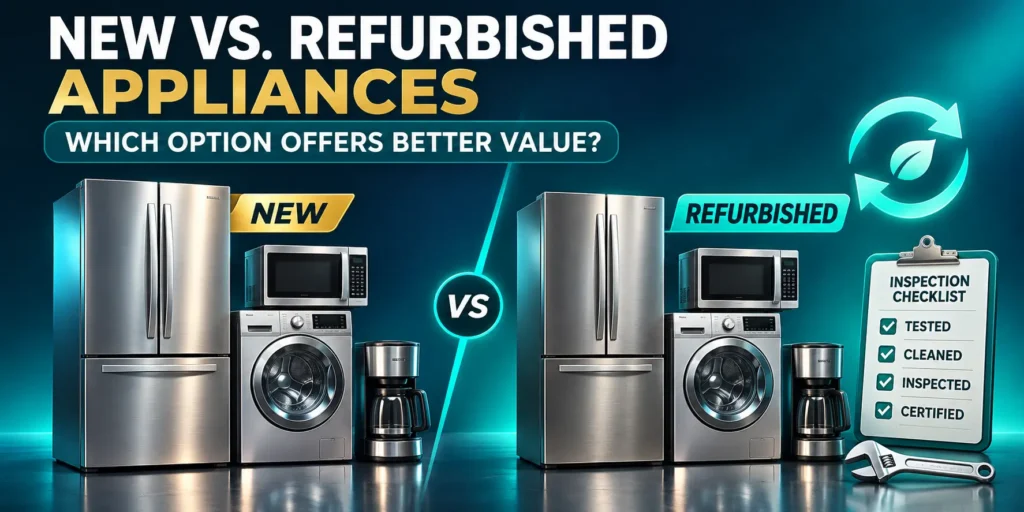
Buying an appliance online involves more than choosing the lowest advertised price. Shoppers may find the same refrigerator, air fryer, vacuum cleaner, or coffee maker listed as new, refurbished, renewed, open-box, or used—often with significant differences in price and protection.
A refurbished appliance can offer excellent value when it has been properly inspected, tested, and sold with a meaningful warranty. However, a low price may not justify missing accessories, cosmetic damage, expensive return shipping, or limited support.
This guide explains how to compare new and refurbished appliances, evaluate the seller, calculate the true cost, and choose the option that provides the best long-term value.
What Is a Refurbished Appliance?
A refurbished appliance is a product that has been returned, inspected, repaired when necessary, tested, and offered for sale again.
The reason for refurbishment can vary. The original customer may have returned the product because of:
- A damaged package;
- A minor cosmetic issue;
- A missing accessory;
- Buyer’s remorse;
- A technical problem;
- A delivery refusal;
- An incorrect model or color;
- A store demonstration.
Refurbished does not automatically mean heavily used. Some products may have been opened but never installed, while others may have required repairs.
The listing should explain the appliance’s condition and who performed the refurbishment.
Refurbished, Open-Box, Renewed, and Used: What Is the Difference?
These terms are sometimes used differently by individual retailers, so always read the listing.
Refurbished
The appliance has normally been inspected and tested. It may have been repaired or had components replaced.
Open-Box
The original packaging has been opened. The appliance may be unused, lightly handled, or returned after a short period.
Renewed
This is generally a marketplace term for a product that has passed a testing and inspection process. The exact standards depend on the platform and seller.
Used
A used appliance has previously belonged to another customer and may not have undergone a formal refurbishment process.
Scratch-and-Dent
The product may be new or functional but have visible cosmetic damage, such as scratches or dents.
None of these labels guarantees the same condition, warranty, or return policy. The written details matter more than the category name.
When Does a Refurbished Appliance Make Sense?
A refurbished appliance may be worth considering when:
- The discount is significant;
- The seller has a strong reputation;
- The appliance was professionally tested;
- A reasonable warranty is included;
- Returns are accepted;
- Replacement parts are readily available;
- Cosmetic appearance is not your main concern;
- The product is not expensive to ship back;
- All essential accessories are included.
Refurbished countertop appliances, robotic vacuums, air fryers, coffee makers, and blenders can be attractive when the price difference is large enough.
The decision requires more caution for refrigerators, ovens, washers, dryers, and other products that are difficult or expensive to return.
When Is Buying New the Better Choice?
A new appliance may offer better value when:
- The refurbished discount is small;
- The product will be used every day;
- Reliability is essential;
- The new version includes a longer warranty;
- Installation is complicated;
- Return transportation would be expensive;
- The appliance has expensive internal components;
- The refurbished seller provides limited information;
- The new model includes important efficiency improvements;
- A coupon reduces the price difference.
Do not compare only the listed prices. A promotion on a new appliance can make it cost almost the same as a refurbished unit.
Before deciding, review current Amazon coupons and deals to determine whether a promotion reduces the price of an eligible new or renewed appliance.
Calculate the True Cost
The cheapest listing may not produce the lowest final cost.
Use the following calculation:
Product price – applied discount + shipping + taxes + installation + required accessories + protection costs
For a refurbished product, also consider:
- Possible return-shipping charges;
- Missing parts;
- A shorter expected service life;
- A limited warranty;
- Potential repair costs;
- Professional inspection or installation.
Compare both options using the final checkout amount—not only the product price.
Example: New vs. Refurbished Coffee Maker
Imagine a new coffee maker priced at $180.
New Model
- Product price: $180;
- Coupon discount: $20;
- Shipping: free;
- One-year warranty: included;
- Final price before tax: $160.
Refurbished Model
- Product price: $125;
- Shipping: $15;
- Six-month warranty: included;
- Final price before tax: $140.
The refurbished model saves $20. Whether that difference is sufficient depends on the seller, condition, warranty, and return policy.
If the refurbished product has missing accessories or the customer must pay return shipping, the new appliance may provide better overall value.
What Is a Good Refurbished Discount?
There is no percentage that works for every product. The appropriate discount depends on the appliance’s condition, age, warranty, and replacement cost.
A meaningful discount should compensate for factors such as:
- Previous use;
- Cosmetic imperfections;
- Reduced warranty coverage;
- Older technology;
- Missing original packaging;
- Potentially shorter service life;
- More complicated returns.
If a refurbished appliance costs only slightly less than a new one, the new product is usually easier to justify.
Compare the refurbished price with the current selling price of a new unit—not with an inflated manufacturer’s suggested retail price.
Check Who Refurbished the Appliance
The refurbisher can be as important as the brand.
A product may have been refurbished by:
- The original manufacturer;
- An authorized service provider;
- The retailer;
- A marketplace seller;
- An independent repair company.
Manufacturer-refurbished products may follow standardized testing procedures, but this should not be assumed without verification.
Look for clear information about:
- The inspection process;
- Components that were replaced;
- Testing standards;
- Cleaning and sanitization;
- Included accessories;
- Cosmetic grading;
- Warranty support.
Avoid listings that use vague phrases without explaining the appliance’s actual condition.
Evaluate the Seller
A trustworthy seller should provide enough information for an informed decision.
Review:
- The seller’s overall rating;
- Recent customer feedback;
- The number of completed sales;
- Comments about product condition;
- Responses to customer complaints;
- Shipping performance;
- Return experiences;
- Warranty claim procedures.
Recent reviews are particularly useful because seller quality and fulfillment practices can change over time.
A low price should not outweigh repeated reports of damaged, incomplete, or incorrectly described products.
Read the Condition Description Carefully
Do not rely only on the word “refurbished.”
The product description should clarify:
- Whether the appliance has cosmetic damage;
- Whether it has been repaired;
- Whether it was tested;
- Whether it was previously installed;
- Which accessories are included;
- Whether the original packaging is included;
- Whether the photographs show the actual item;
- Whether replacement parts were used.
If the listing uses generic product photos, request clarification about visible wear when appearance matters.
Confirm That All Accessories Are Included
Missing accessories can eliminate the apparent savings.
Depending on the appliance, confirm the inclusion of:
- Power cords;
- Water hoses;
- Drain hoses;
- Mounting brackets;
- Remote controls;
- Filters;
- Trays;
- Baskets;
- Carafes;
- Mixing attachments;
- User manuals;
- Installation kits.
Calculate the cost of purchasing missing parts separately.
An inexpensive stand mixer without its attachments or a coffee maker without its carafe may not be a practical deal.
Compare the Warranty
Warranty coverage is one of the most important differences between new and refurbished appliances.
Check:
- Who provides the warranty;
- How long the coverage lasts;
- Whether parts and labor are included;
- Whether shipping is covered;
- Whether in-home service is available;
- Which problems are excluded;
- Whether a deductible applies;
- How claims must be submitted.
A 90-day seller warranty is not equivalent to a one-year manufacturer’s warranty.
Also confirm that the warranty is valid in the United States, especially when purchasing from an international marketplace seller.
Review the Return Policy Before Ordering
Appliances can be difficult and expensive to return.
Before purchasing, determine:
- The number of days allowed for returns;
- Whether opened appliances are eligible;
- Who pays return shipping;
- Whether a restocking fee applies;
- Whether the original packaging is required;
- How damaged products are handled;
- Whether the seller provides a prepaid label;
- How long refunds take.
For large appliances, confirm whether the retailer arranges pickup. Freight return costs can exceed the savings generated by buying refurbished.
Cosmetic Damage vs. Functional Damage
A scratch or dent may not affect performance, but the location and severity matter.
Minor cosmetic imperfections may be acceptable when:
- The appliance will be placed under a counter;
- The damaged side will face a wall;
- The product will be used in a garage or laundry room;
- The controls and doors work correctly;
- The discount is substantial.
Be more cautious when damage affects:
- Door alignment;
- Seals and gaskets;
- Hinges;
- Electrical connections;
- Water connections;
- Ventilation;
- Structural stability;
- Touchscreens or control panels.
A dent near a refrigerator door seal, for example, can be more serious than a scratch on a side panel.
Check the Model Number and Manufacturing Date
Two appliances can look nearly identical while offering different features, efficiency levels, or replacement-part availability.
Confirm:
- The complete model number;
- The production year;
- The product generation;
- Capacity and dimensions;
- Included features;
- Energy consumption;
- Current replacement model;
- Availability of parts.
An older refurbished model may be inexpensive because it has been discontinued. That is not always a problem, but repairs may become more difficult.
Measure the Available Space
Before ordering any major appliance, measure:
- Width;
- Height;
- Depth;
- Doorways;
- Hallways;
- Staircases;
- Elevator dimensions;
- Ventilation clearance;
- Space required to open doors;
- Distance to electrical, gas, or water connections.
Do not rely on the product category alone. Two refrigerators described as the same size may have different external dimensions.
A return caused by incorrect measurements can be costly, especially for a refurbished appliance.
Verify Voltage and Plug Compatibility
This is especially important when purchasing from international sellers.
Confirm:
- Input voltage;
- Frequency;
- Plug type;
- Wattage;
- Required outlet;
- Whether the product is intended for U.S. use;
- Whether professional installation is required.
A simple plug adapter does not convert voltage.
Products intended for different electrical systems may not function correctly and could create a safety risk. Follow the manufacturer’s specifications and consult a qualified professional when necessary.
When comparing imported small appliances, accessories, and replacement components, check available AliExpress coupons and promotions while carefully reviewing voltage, seller ratings, shipping times, and warranty limitations.
Consider Energy Efficiency
An older refurbished appliance may cost less initially but consume more electricity or water than a newer model.
Review:
- Estimated annual electricity use;
- Water consumption;
- Energy-saving modes;
- Capacity;
- Standby power consumption;
- Efficiency certifications;
- Estimated annual operating cost.
For an appliance used every day, operating expenses can be more important than a small difference in purchase price.
Compare the expected ownership cost over several years rather than focusing exclusively on checkout savings.
Account for Installation Costs
Installation costs can change the comparison between new and refurbished appliances.
Potential expenses include:
- Delivery;
- Professional installation;
- Water lines;
- Electrical cords;
- Dryer vents;
- Gas connectors;
- Mounting hardware;
- Cabinet modifications;
- Removal of the old appliance;
- Disposal of packaging.
Some retailers include installation discounts with new appliances but not with refurbished products.
Use the same installation requirements when comparing the final totals.
Shipping Damage Is an Important Risk
Large appliances may be damaged during transportation, even when they leave the warehouse in good condition.
At delivery:
- Inspect the packaging.
- Check the appliance for dents and cracks.
- Verify the model number.
- Confirm that accessories are present.
- Photograph visible damage.
- Test basic functions when possible.
- Record problems on the delivery receipt.
- Contact the seller immediately.
Do not discard the packaging until you know the appliance works and understand the return requirements.
Should You Purchase an Extended Protection Plan?
An extended warranty may provide additional coverage, but it should be evaluated separately.
Review:
- The protection plan’s price;
- Coverage duration;
- Deductibles;
- Repair limits;
- Replacement conditions;
- Excluded failures;
- Service locations;
- Cancellation terms.
Adding an expensive plan to a refurbished appliance can reduce or eliminate the original savings.
First determine what protection is already provided by the seller, manufacturer, marketplace, or payment method.
Is a Refurbished Major Appliance Worth It?
A refurbished refrigerator, washer, dryer, oven, or dishwasher may offer value, but these purchases require extra care.
Major appliances are:
- More expensive to transport;
- More complicated to install;
- Harder to return;
- More disruptive when they fail;
- More dependent on local repair services.
A strong warranty, clear condition report, professional refurbishment, and reliable delivery process are particularly important.
If the seller cannot provide these protections, a new appliance purchased during a promotion may be the safer option.
Which Appliances Are Easier to Buy Refurbished?
Refurbished purchases are often easier to evaluate when the appliance is:
- Small enough to return by standard shipping;
- Easy to test immediately;
- Supported by available replacement parts;
- Sold with a clear warranty;
- Not essential to daily household operation.
Examples may include:
- Air fryers;
- Blenders;
- Coffee makers;
- Food processors;
- Stand mixers;
- Robotic vacuums;
- Countertop microwaves;
- Portable fans.
This does not guarantee that every refurbished unit is a good deal. The seller and condition remain essential.
Red Flags to Avoid
Consider choosing another listing if you notice:
- No clear condition description;
- No return policy;
- No warranty information;
- Extremely limited seller history;
- Repeated complaints about defective products;
- Missing model numbers;
- Stock photographs presented as the actual item;
- Pressure to pay outside the marketplace;
- A price that appears unrealistically low;
- Unclear voltage or plug information;
- Expensive return shipping;
- Claims that cannot be verified.
Never send payment outside the official platform in exchange for an additional discount.
New vs. Refurbished Appliance Checklist
Before completing the purchase, confirm:
- The model number is correct;
- The appliance fits the intended space;
- The condition is clearly described;
- The seller has a reliable history;
- The refurbishment process is explained;
- All essential accessories are included;
- The voltage is compatible;
- The warranty is adequate;
- The return policy is acceptable;
- Shipping costs are included;
- Installation expenses were calculated;
- Replacement parts are available;
- Energy use was considered;
- The final price was compared with a new model;
- Every coupon was applied successfully.
Frequently Asked Questions
Are refurbished appliances reliable?
They can be reliable when properly inspected, tested, and sold by a reputable company. Reliability depends on the product’s history, refurbishment quality, age, and warranty.
Is refurbished the same as used?
Not necessarily. A refurbished product should normally undergo inspection and testing, while a used product may be resold without a formal restoration process.
Do refurbished appliances include a warranty?
Some do, but coverage varies. Confirm the provider, duration, exclusions, and claim process before purchasing.
How much should I save by purchasing refurbished?
There is no universal minimum. The discount should be large enough to compensate for the product’s condition, shorter warranty, previous use, and potential return difficulty.
Are open-box appliances better than refurbished appliances?
Not automatically. An open-box product may have seen little use, but its condition and testing process still need to be verified.
Can I use a coupon on a refurbished appliance?
It depends on the retailer and promotion. Some coupons exclude renewed, used, open-box, or marketplace products.
Should I buy a refurbished refrigerator or washing machine?
It may be worthwhile when the product was professionally refurbished and includes reliable delivery, returns, and warranty coverage. Major appliances require more caution because they are expensive to install and return.
What should I test first?
Check the controls, doors, seals, heating or cooling functions, unusual sounds, water connections, included accessories, and any features mentioned in the listing.
Choose Long-Term Value, Not Just the Lowest Price
Refurbished appliances can provide meaningful savings, but the discount is only one part of the decision. Product condition, seller reputation, warranty coverage, return costs, energy consumption, and installation requirements all affect the real value.
Compare the refurbished appliance with the current price of an equivalent new model. Apply available coupons, include every fee, and consider how difficult the product would be to return or repair.
The best purchase is not necessarily the newest or cheapest appliance. It is the option that delivers dependable performance, appropriate protection, and the lowest reasonable ownership cost.